

The Sawyer Mini has lived in the top pocket of my pack since 2021. Five seasons now, mostly in the Uintas along the Mirror Lake Highway, a few weekends in the Wasatch above Ogden, and one hot spring trip near Moab. It has never made me sick. It has also never once been a pleasure to use. That is the honest shape of the thing: it does the job and it makes you work for it. I switched to it from iodine tablets and I would make that switch again. But most of what I read before buying skipped the parts that actually decide whether you will like it, so that is what this is about.
The iodine tablets came first, because they were cheap and simple and they worked. What they also did was make every bottle taste like a swimming pool and add half an hour of waiting to the end of a long day. When you get into camp with a sore back and a left knee that has been complaining since the descent, the last thing you want is to sit on a rock watching a tablet dissolve. The Sawyer Mini gave me water I could drink within a minute and water that tasted like water. That alone was worth the change. Everything after that is a trade, and I will lay the trades out one at a time.
The Quick Verdict
A reliable, tiny filter that has never failed me, and that asks for patience and hand strength every single time I use it.
Amazon Check Today's Price →Five seasons, no repairs, one part I keep replacing
The filter itself has never needed anything from me. The soft pouch it comes with is the piece that wears out. Here is what the whole kit costs today.
Amazon Check Today's Price on Amazon →What It Actually Is, and What It Is Not
The Sawyer Mini is a hollow fiber membrane filter, and the listing rates the membrane at 0.1 micron absolute. In plain terms, it strains water through a bundle of very fine tubes, and the holes are small enough that bacteria and protozoa cannot get through. Sawyer rates it at 99.999999 percent of bacteria and 99.9999 percent of protozoa, and it also removes microplastics. It weighs 2 ounces, 41 grams when I put it on the kitchen scale, and it fits in the palm of my hand. The rated capacity is 100,000 gallons, which for a person taking a handful of trips a year is essentially the rest of your life.
What it is not is a purifier. The listing claims bacteria and protozoa, not viruses, so if you are heading somewhere that viruses in the water are a genuine concern, this is not the tool for that job and you should not talk yourself into believing it is. It also has no moving parts, no batteries, no chemicals and no electronics of any kind. Manual operation means exactly that: you supply the pressure with your hand. That is the entire design, and it is both the reason it never breaks and the reason it is not effortless.
The rest of the box is the 16 ounce pouch, a drinking straw and a cleaning plunger. That is the full kit. There is no gauge, no warning light, no indicator of any kind telling you the membrane is loaded up or worn out. You learn to read it by feel and by flow, which is a slower way to know things but it has not let me down yet. If you want a piece of gear that reports on itself, this is not that piece of gear, and I would rather say so up front than have you find out at a creek.
How I Use It, Which Is Probably How You Would
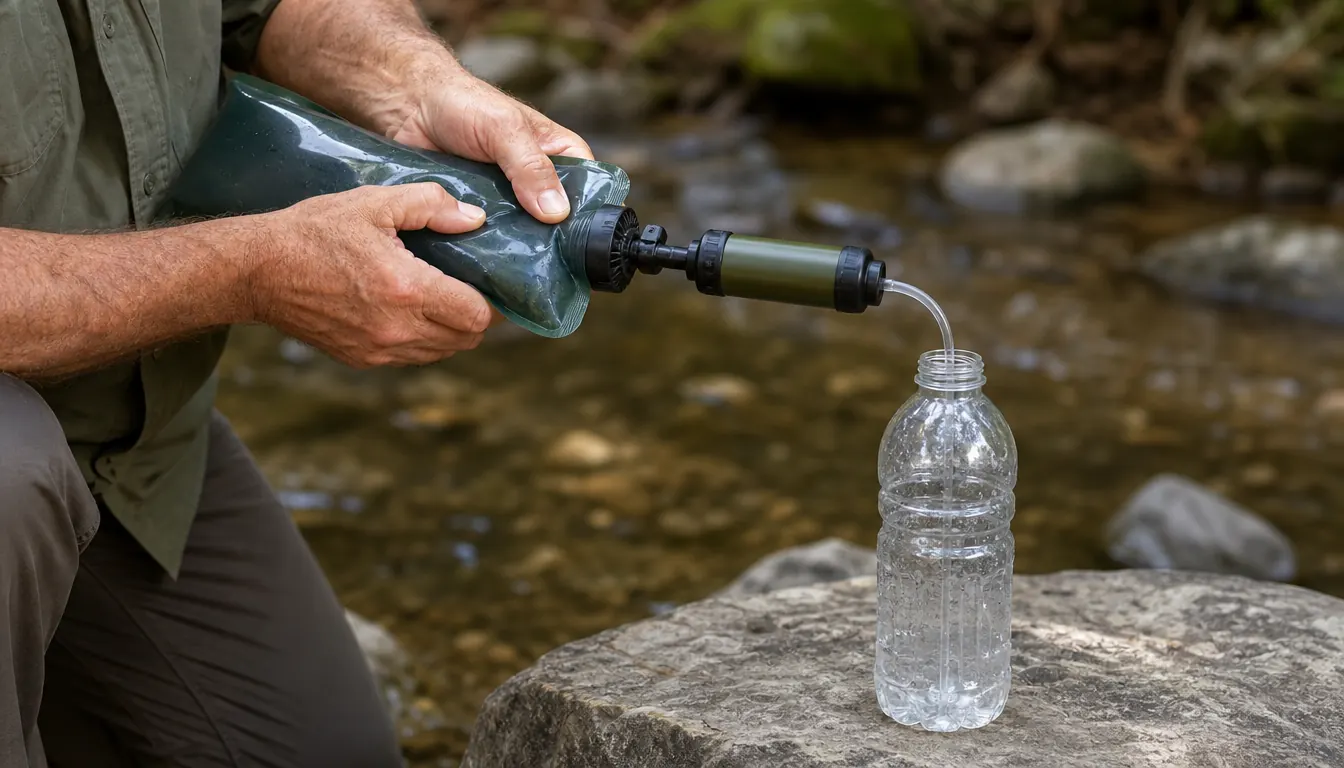
My routine has not changed in five seasons. I fill the 16 ounce pouch at a creek or a lake edge, screw the filter on, and squeeze into a spare 1 liter bottle. Three or four rounds gets me enough for dinner, breakfast and the walk out. I backflush it with the included plunger after every trip, let it dry with the caps off, and store it loose in a small stuff sack with the plunger. On cold nights it goes into the sleeping bag with me. Of the four things in the box, I have used all of them except the straw.
The filter threads onto standard 28 mm disposable water bottles, which matters more than it sounds. A 1 liter bottle from a gas station in Ogden costs almost nothing, weighs less than any hard bottle I own, and can be swapped out when it gets funky. The filter also threads onto most hydration pack lines. Wide mouth bottles will not fit, and the listing is clear that 28 mm is the size, so check what you already own before you plan around it. That is a small thing that becomes a large thing if you discover it at the trailhead.
Where I fill depends on the trip. The creeks off the Mirror Lake Highway are clear and cold and the filter barely notices them. A muddy little seep near Moab is a different job entirely, and that is where the pouch earns its keep, because you can scoop from a shallow pool without dunking anything mechanical. I let silty water settle in the bottle for a few minutes before I run it through. That single habit has saved me more backflushing than any accessory I have bought.
Two Mistakes I Made Early On
The first was not tightening the filter onto the pouch far enough. A half turn short and you get a fine spray of creek water across your shirt and a great deal of squeezing with nothing to show for it. The second was filling the pouch right to the brim and then fighting the filter on, which just pushes water out through the threads. Leave a little headroom. Neither of these is a defect in the product. Both cost me a few confused minutes on my first trip out, and neither has happened since.
The third took longer to notice. I stored it wet, sealed in a bag, and it sat in the pack for a month before the next trip. Nothing catastrophic happened, but the first squeeze tasted flat and the flow was poor until I backflushed it properly at the kitchen sink. Now it dries on a towel on the workbench for two days before it goes into the bin with the rest of the gear. That habit is worth more than anything anyone will sell you to go with this filter.
Where It Earns Its Place
The weight is the obvious argument, and I will not pretend it is not. Two ounces in the top pocket is nothing. After a day carrying a pack at 58 with a lower back that has opinions, I notice two ounces far less than I notice a pump. Pumps have handles, hoses and a connection that can fail at either end. The Sawyer Mini has a membrane and a plastic body. If it loads up you backflush it. If you drop it on a rock it keeps working. I have never had a trip where it failed, and that record is the whole reason I have never gone shopping for something else.
The second thing it earns is trust. I have drunk from small creeks in the Uintas and from a beaver pond I would not otherwise have touched, and I have not been sick once in five seasons. That is not a clinical trial. It is one man's logbook, and I say it that way on purpose. But it lines up with what the filter is rated to do, and it is better evidence than a marketing page will ever give you. The third thing is quieter: it removed the waiting and the aftertaste from my water routine, and I stopped thinking about water treatment at all, which is the highest compliment I can pay a piece of gear.
It also survives neglect better than I expected. There is no o-ring to lose, no valve to stick, no lever to snap. The threads are still crisp after five seasons of screwing onto bottles that were not always clean. I have dropped it on granite twice. I have frozen it exactly zero times, because I am careful about that one, and I will get to why in a minute. For a thing that lives in a pocket and gets treated like a pocket item, it has held up better than the pouches it came with.
What I Liked
- Weighs 2 ounces and disappears into a pack pocket
- No moving parts, no batteries, nothing to prime or maintain
- Rated for 100,000 gallons, which is decades of weekend trips
- Threads onto standard 28 mm bottles and most hydration pack lines
- Never made me sick in five seasons of filling from creeks and ponds
- Backflushing with the included plunger restores most of the flow
Where It Falls Short
- Squeezing three liters takes real hand and forearm work
- Flow is thin to begin with and gets thinner with age
- Freezing destroys the membrane silently, with no visible sign
- The 16 ounce pouch is the weak link and I have replaced it twice
- Not rated for viruses, so it is the wrong tool in some places
- The included straw has never been useful to me
I have drunk from a beaver pond I would not otherwise have touched, and in five seasons it has not made me sick once. That is one man's logbook, not a trial, but it is more than a listing page can tell you.

The Parts Nobody Mentions
Squeezing is work, and it is the thing I most wish someone had told me plainly. Filling three liters takes me somewhere around ten minutes of steady hand pressure, and my forearms know it by the end. If the pouch is not full you are squeezing air and getting nothing back. If the water is cold, everything stiffens up and it goes slower. If Ray and I are sharing it, you double the time. The filter turns water treatment into a small physical chore at exactly the hour when you are tiredest. That is a fair trade for two ounces, but it is a trade, and you should walk into it with your eyes open.
Flow slows over the years. A new Sawyer Mini pushes a thin stream. A five season old one pushes a thinner one. Backflushing brings most of it back, not all of it. Silty water loads the membrane fast, and I have stopped mid-trip to backflush after a muddy fill near Moab. If you are drawing from clear mountain creeks, this is close to a non-issue. If you are drawing from anything with sediment in it, strain it through a bandana or let it settle first. That advice is not printed anywhere on the packaging in any emphatic way.
Freezing will ruin it, and this is the one I wish were stamped on the pouch in letters an inch tall. A hollow fiber membrane is full of water after a trip. If that water freezes, the ice expands and tears the fibers. The filter will still pass water afterward. It will look completely fine. It will simply stop filtering what it claims to filter, and nothing about it will tell you. In the Uintas in late September that is a live risk. Mine sleeps in the bag with me, which sounds fussy until you think about what a dead filter means on day two of a three day trip.
The straw is included and I have never once used it. Drinking through a filter at the end of a straw is slow and awkward, and I have never been in a spot where it beat the pouch. Keep it as a backup if it makes you feel better. The 16 ounce pouch is the useful piece, and it is also the piece that quits first. Two replacements in five seasons. That is not a complaint about the filter. It is a note about the bag, and it is the reason I now carry a spare bottle instead of a spare pouch.
Five Seasons In: What Has Held Up
The filter body has held up completely. No cracks, no leaks at the threads, no change in how it seats on a bottle. The plastic is not delicate, but it is not armored either, and I would not throw it loose into a pack full of sharp things. Mine lives in a stuff sack with the plunger. The caps matter more than people give them credit for. Keep both on when it is in the pack, because grit on the outlet side is grit you end up drinking. I rinse the outside before I screw it onto a clean bottle, and that is the entire maintenance routine beyond backflushing.
The honest summary after five seasons is that the Sawyer Mini has cost me almost nothing in attention and a moderate amount in effort. I have never repaired it. I have never replaced it. I have never had to think about it at six in the morning when all I wanted was coffee. Two pouches have worn out and I expect a third will eventually. That is a fair record, and I would rather write it down plainly than gush about a piece of plastic the size of my thumb.
Who This Is For
This is for the person taking one or two night trips who wants water treatment to be one less thing to plan. If you are filling from clear creeks and lakes in the Uintas or the Wasatch, if the pack already hurts before you add anything to it, and if you would rather spend ten minutes squeezing than carry a pound of pump, the Sawyer Mini is a sensible answer and I would hand it to you without hesitation. It also suits a car camper who wants a filter living in the truck for the just-in-case trips, since it can sit for a year and still work when you pull it out.
It suits people who do not mind a small physical routine and who will actually backflush the thing when they get home. The filter rewards a little discipline and punishes none of it. Ten minutes at the garage sink after a trip is the difference between getting five seasons out of it and getting one. If that sounds like something you will genuinely do, this is a remarkable amount of capability for something the size of a shot glass.
Who Should Skip It
Skip it if you are making water for four people or more. The squeezing does not scale, and you will spend your whole evening working a pouch while everyone else eats dinner. Skip it if viruses are a real concern where you are going, because it is not rated for them and no amount of squeezing changes that. Skip it if you want water on demand at camp without effort. That is a legitimate preference, and a pump or a gravity setup serves it better. And skip it if you are the sort who will put it away wet in September and not look at it again until June.
There is also a version of this decision that is about your hands. If squeezing a bladder hard for ten minutes bothers your grip, your wrists or your shoulders, the weight you save is not worth the pain at the end of a long day. That is not a knock on the filter. It is a knock on the idea that lighter is always better for everybody. At 58 with a back that lets me know about it, I have stopped believing that one, and I would rather carry an extra few ounces of something easier than spend the evening working for my water.
The filter I would hand you, with the pouch caveat attached
Two ounces, no moving parts, and five seasons without a single failure. Buy it for the filter and treat the soft pouch as the consumable it is.
Amazon Check Today's Price on Amazon →