
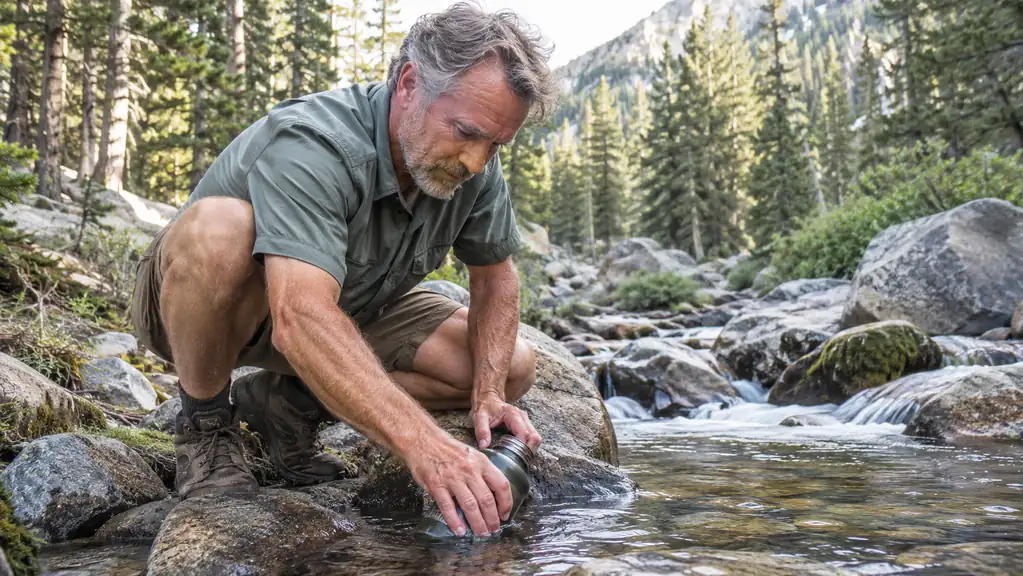
Five seasons ago I stopped carrying iodine tablets into the Uinta Mountains, and it was not because iodine ever failed me. It was the wait. Twenty minutes of watching a bottle sit on a rock while my hands were cold and my pack was still on my back, and then drinking something that tasted like a swimming pool. The Sawyer Mini replaced that with a squeeze and about thirty seconds. I bought mine in 2021 and it has ridden in the same pocket of the same pack ever since.
Here is the honest part up front. I ran no lab tests and sent no water samples anywhere. I am a 58-year-old man from Ogden who takes one or two night trips when I can get away from caring for my mother, and my evidence is five seasons of drinking from creeks, lakes and one very silty drainage down near Moab without ever getting sick. That is the whole basis for this review. If you want colony counts, this is not the article for you. If you want to know whether a small filter still works after five years of being stuffed in a pack and dropped on gravel, keep reading.
The Quick Verdict
The simplest way I have found to make backcountry water drinkable, as long as you backflush it, dry it, and keep it out of a hard freeze.
Amazon Check Today's Price →Five seasons, one filter, and I have never once thought about replacing it
Two ounces in the pack and about thirty seconds from creek to bottle. That is the whole pitch, and it has been enough for me. Current price and the full listing are on Amazon.
Amazon Check Today's Price on Amazon →How I've Used It
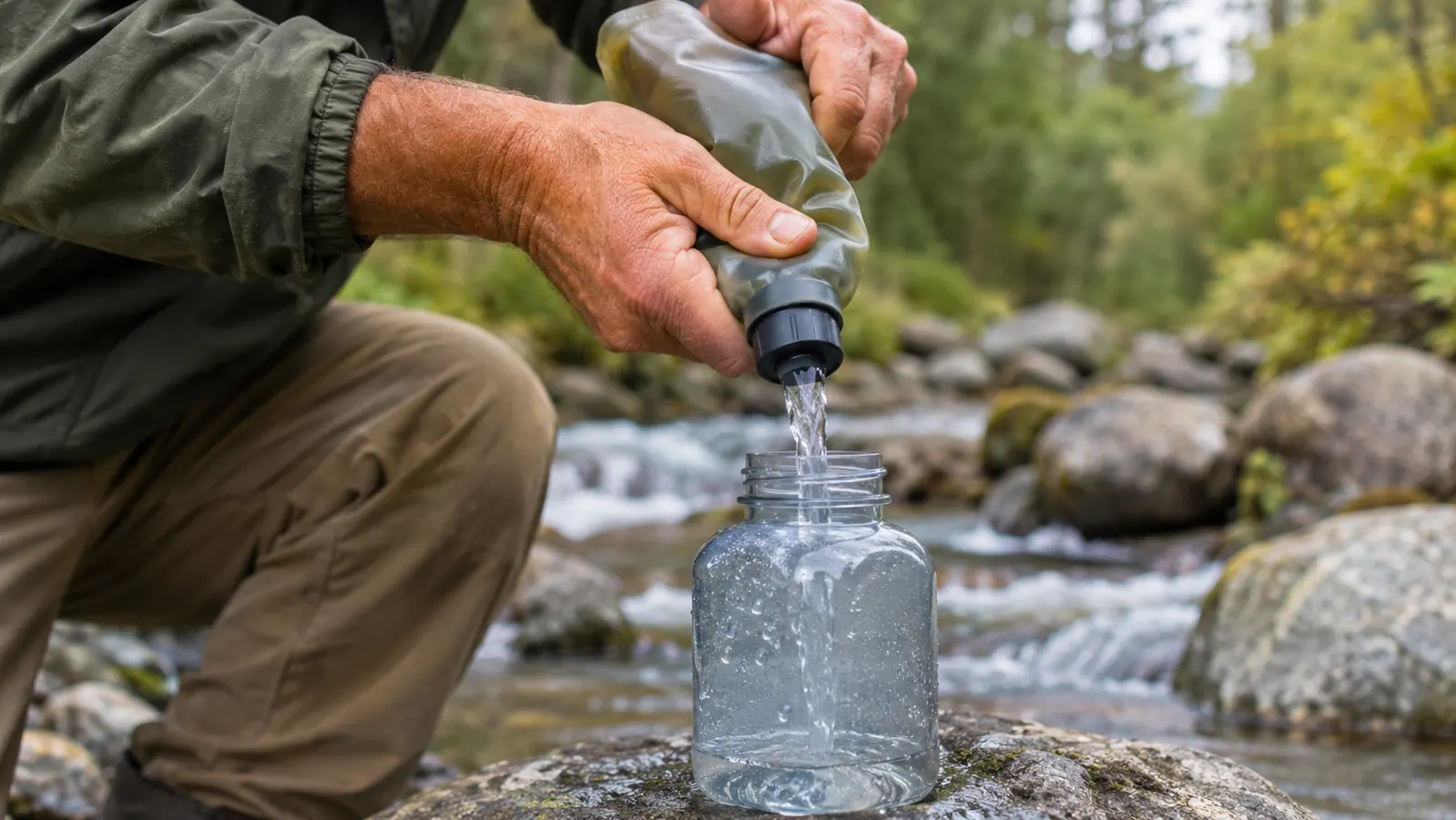
The routine has not changed since the first trip. I crouch at the edge of the water, fill the 16-ounce pouch, screw the Sawyer Mini onto the top, and squeeze into a spare one-liter bottle I carry empty. Cap the bottle. Drink. On a hot afternoon I will do that two or three times in a row before I put anything away, because the pouch is small and I am always thirstier than I planned to be.
Where I go has tested it enough for my purposes. The trailheads off the Mirror Lake Highway in the Uintas, the creeks in the Wasatch above Ogden, and spring trips down toward Moab where water is scarce and often cloudy with silt. Cloudy water is where a filter earns its keep, because on those trips the alternative is hauling every drop I plan to drink, and my lower back has opinions about that.
One trip sticks with me. July, a small lake off the Mirror Lake Highway, the kind of warm afternoon where you drink more than you carry. I filled the pouch five times in an hour and never touched a tablet. My friend Ray came along and had left his filter in the truck, so he drank out of my bottle and complained about the warm water. That is the entire story. It is not dramatic and I am not going to dress it up.
The after-trip part is where most people go wrong, I think. When I get home I fill the pouch with clean water, screw the filter on, and push the included plunger through to backflush it. Then it comes apart and sits on a dish towel in the garage until it is bone dry. On the trail in cold weather it goes into the sleeping bag with me at night. Five seasons of that and mine still flows. I am not a careful man about gear in general. I am careful about this one thing because it is the one thing standing between me and a very bad week.
What Five Seasons Actually Wore Out
Almost nothing on the filter itself. The housing is intact, the threads still bite, and the water coming out the bottom looks the same as it did in 2021. The listing rates the filter for up to 100,000 gallons, and I have probably run a few hundred through it, so I am not going to pretend I have stress-tested that number. For one person doing short trips, that rating might as well say forever.
What I have noticed most is that the thing has never failed in a way I could see. No cracked housing, no leak at the threads, no water coming out cloudy. I check the flow before every trip by squeezing a pouch of tap water through it at the kitchen sink, and if it comes out slow I backflush it a second time before I pack it. That check takes two minutes and it is the only maintenance I do.
The pouch is a different story. Mine has been folded, sat on, frozen stiff and thawed out, and I am on my second one. That is the part of the system that wears out first, not the filter. If you buy this, plan on the pouch being the piece you replace. The plunger lives in a zip bag in my pack and has never given me trouble, though I did nearly lose it in the dirt outside a tent one night, which was my fault and not Sawyer's.
The Flow Rate Question
A new Sawyer Mini is quick. Water moves through it about as fast as you can squeeze, and a liter takes under a minute if you are organized. After three or four trips it slows down noticeably. That is not a defect. It is a hollow fiber membrane loading up with the fine material it pulled out of the water, and backflushing with the plunger brings most of that speed back. Most. Not all. Mine today is slower than it was in 2021, and I can feel the difference on a cold morning when my hands do not want to work.
There is a trick to it beyond a single backflush. Fill the pouch with clean water, backflush with the plunger, then do it a second time with fresh water. That second pass rinses out a surprising amount of brown, and if you do it after every trip instead of once a season you will notice the difference on the first squeeze of the next trip. The filter is rated down to 0.1 microns absolute, which is fine enough for bacteria and protozoa, and the listing says it also takes out microplastics. I cannot verify any of that with my own eyes. I can verify that I have not been sick.
This is the real tradeoff and nobody selling you one will lead with it. A pump pushes water for you. A squeeze filter makes your hands do the work, and if you have a bad grip, arthritic knuckles, or you are filling four liters at the end of a long day, that gets old fast. I still take the Mini because a pump is more parts, more weight, and more to break, but I am honest that on a two-person trip the squeezing is the whole job and it falls to me.
Cold Nights and the Freeze Problem
Hollow fiber filters and hard freezes do not get along. Water trapped inside the fibers expands when it freezes and can tear them, and the miserable part is that it still looks fine afterward. It still passes water. It just may not be filtering anything. That happened to a friend of mine, or rather he suspects it did, and he has never trusted that filter since.
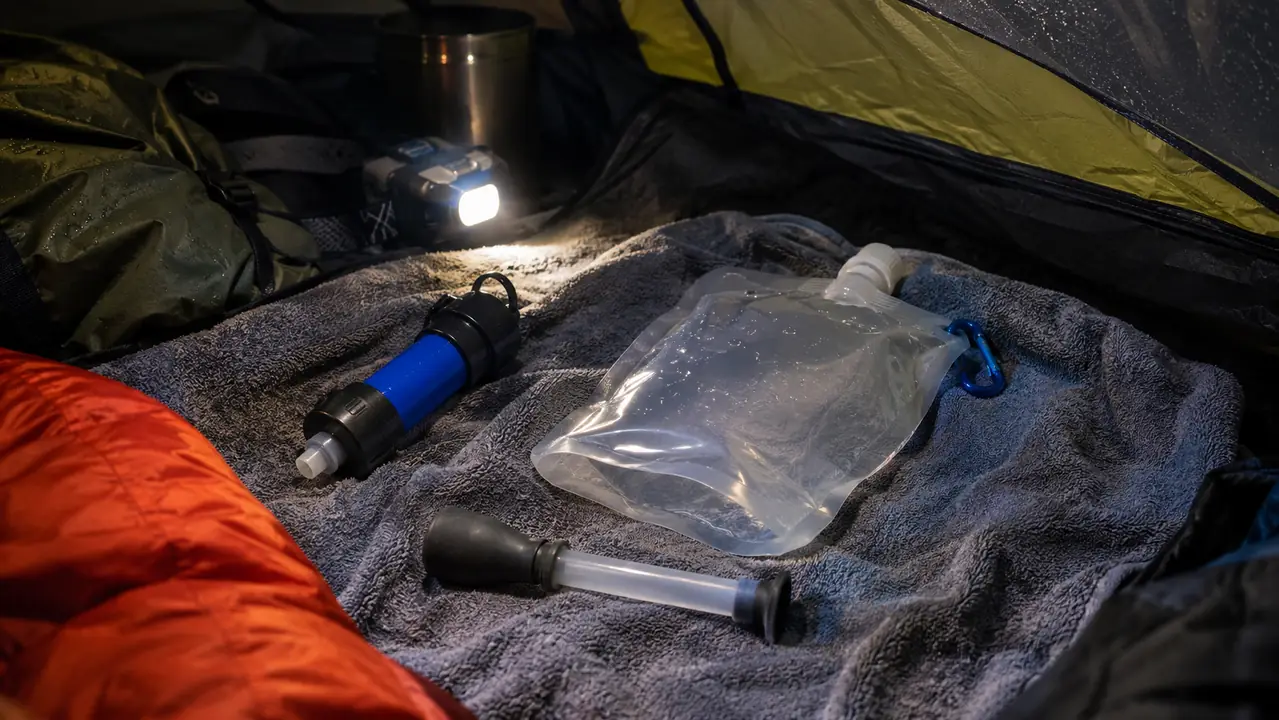
My rule is simple. In late September in the Uintas, when it drops to around 28 degrees at night, the filter sleeps in the bag with me. I filter whatever I need for the evening before the temperature falls, and in the morning I take the filter out, let it warm in a jacket pocket, and go find liquid water. Five seasons of that and I have never frozen one. I know exactly one person who has, and he is the reason I am strict about it.
I will add one thing that surprised me. Keeping it warm is not just about not breaking it. A cold filter is a slow filter, so the same filter that takes thirty seconds in August can take two minutes in October. Sleeping with it solves both problems at once, and it costs you nothing but a little space in the bag next to your socks.
The Pouch, the Straw, and the Small Annoyances
Two things in the box I do not use. The drinking straw is a decent idea and I have used it exactly once, standing in a creek, feeling like I was drinking from a garden hose. The 16-ounce pouch is the thing I do use, and it is the weakest part of the kit. Sixteen ounces is one big glass of water. A liter takes two fills. On a hot day that is a lot of crouching with a stiff back.
The threads do fit a standard 28 mm disposable water bottle, which is useful when you want to filter into something sturdier than a soft pouch, and they will connect to a hydration pack line if that is how you travel. I have used both setups. Neither changed my life. What did help was learning to squeeze slowly and steadily instead of crushing the pouch, because a hard squeeze just forces water past the seams and gets your sleeve wet.
My workaround for the pouch is unglamorous. I carry a spare soft one-liter bottle and treat the 16-ounce pouch as a scoop and a squeezer, not as my drinking supply. That means two fills instead of six, and I am not standing in the water any longer than I have to be. If you only ever buy one accessory for this filter, buy a second pouch. They are cheap and they are the part that fails.
What I'd Consider Instead, and When
If the squeezing is the part that bothers you, a gravity setup with a larger bag is the honest upgrade and I will not argue with you about it. If you want one device that also handles viruses, that is a different class of product and worth the extra weight for travel outside the country. If you are pumping for four people at a base camp, a pump makes sense and everyone knows it. What I would not do is go back to iodine. The wait and the taste are worse than the work.
What I Liked
- Two ounces in the pack, which means I never notice it is there
- About thirty seconds from creek to bottle, with no chemical aftertaste
- Backflushing with the included plunger brings most of the flow back
- Rated for up to 100,000 gallons, which for one person is close to forever
- Screws onto the included pouch, standard 28 mm bottles and hydration lines
- Five seasons in and the housing and threads still look and work like new
Where It Falls Short
- The 16-ounce pouch is small, so a liter takes two fills
- Flow slows noticeably as the membrane loads up, and squeezing gets old on a big fill
- A hard freeze can damage it silently, with no way to tell by looking
- The pouch, not the filter, is the part that wears out first
- It is hand work, which matters if your grip is not what it was
I have never once thought about replacing the filter. I have thought plenty about replacing the pouch.
Who This Is For
This is for the person doing one or two nights out with water somewhere on the route, or the car camper who wants a filter in the truck for the what-if. It is for someone who would rather spend thirty seconds squeezing than twenty minutes waiting on tablets, and who does not mind that the work is done by hand. It suits a solo hiker or a pair. It suits a stiff-backed 58-year-old who counts ounces only when they are on his own shoulders, which is to say it suits me.
It also suits the person who already carries too much and knows it. I am not an ultralight guy and I never will be, but a filter that weighs about what a candy bar weighs is an easy yes when the alternative is a liter of water per person per day. That is the actual argument here, and it is stronger than any spec sheet.
Who Should Skip It
Skip it if you are treating water for a family at a base camp, where a gravity bag hanging from a branch will beat this without arguing. Skip it if your hands are not up to repeated squeezing, or if you want something that sits on the table while you set up camp. Skip it if you travel outside the country, where viruses in the water are a real concern and this filter is not rated for them. And skip it if you are the person who will leave it in a freezing truck overnight, because the failure is silent and you will not know until it matters.
If your water plan is still tablets and hope, this is the fix
One filter, one pouch, one plunger, and a routine you can actually keep. Mine is going into its sixth season this summer. Current price is on Amazon.
Amazon Check Today's Price on Amazon →