
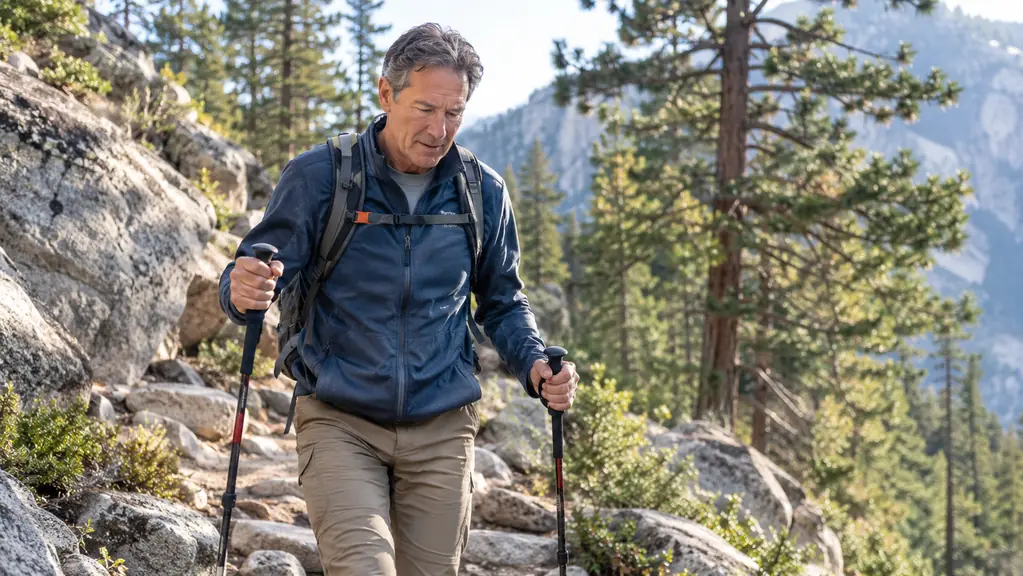
I bought the Cascade Mountain Tech trekking poles in the summer of 2023, a few days after a descent off Bald Mountain in the Uintas left my left knee swollen for a week. I am 58, I live in Ogden, and I have a lower back that files complaints before my legs do. The knee was the last straw. I did not want to become the guy who talks about his knee at every trailhead, but I also did not want another Sunday on the couch with an ice pack. So I picked up a pair and told myself I would use them on every descent for a season. That was three seasons ago.
These are not fancy poles. They are aluminum, they break down to 26 inches, and they have cork and EVA grips. The listing shows a 4.6 average from more than 14,000 reviews, and the current price is low enough that I did not feel like I was making a statement. I wanted a tool, not a personality. What follows is what three seasons in the Wasatch and the Uintas did to them, and to my knee.
The Quick Verdict
For a stiff left knee and a budget that does not stretch to carbon, these do the job on long descents. They are not the lightest, and the locks need a glance now and then, but I have not found a reason to replace them.
Amazon Check Today's Price →The pair I reach for when the trail tilts downhill
If your knee decides how far you go, start with a pole that adjusts from 26 to 54 inches and takes a carbide tip. I have used these for three seasons.
Amazon Check Today's Price on Amazon →How I've Used It
I use both poles on every descent. On flats I sometimes carry them, one in each hand, and on climbs I shorten them a few inches. The routine is simple: at the top of a drop, I plant the left pole, then the right, and let my arms take some of the load before my knee does. On the steep, loose stuff above Ogden, that rhythm is the difference between walking down and limping down.
My trips are short. I care for my mother on weekdays, so most outings are one night, sometimes two, planned around a weather window. I am not testing these on a thru-hike. I am testing them on the Mirror Lake Highway trailheads, on the Wasatch trails above town, and on a few spring trips near Moab. The poles live collapsed behind the seat of my 2014 Tacoma. They come out for day hikes with Carla, for solo overnights, and for the trips I take with my friend Ray.
The first season, I was skeptical. I had used a single pole years ago and felt like I was carrying a rake. Two poles felt more natural. I also noticed that my hands did not blister, which I credit to the cork grips and to the fact that I stopped gripping them like a hammer. I let the grips sit in my palm and I use the extended lower section when I am climbing, which the title calls an extended down grip. It gives me a place to hold when the trail pitches up without shortening the pole.
The clearest test came in late September, on the way down from Fehr Lake. The top half of that descent is a staircase of rock slabs and loose gravel, and I had been thinking about it since I parked the truck. I lengthened both poles by about three inches at the top, planted them a little wider than my feet, and went down slower than I wanted to. It took me 50 minutes. The year before, without poles, the same stretch took me 40 and cost me four days of walking sideways down the hallway at home. I will trade ten minutes for four days every single time.
What the Aluminum and Cork Actually Feel Like on a Long Descent
The shafts are 6061 aluminum. That matters to me because aluminum bends before it breaks, and I have seen carbon poles snap when a hiker catches one between rocks. I am not easy on gear. I have jammed these into talus, stepped on them, and once watched one slide off a boulder and clatter down ten feet of granite. It came back with a scuff and nothing else. That is the trade Cascade Mountain Tech made with these poles, and it lines up with how I actually hike. The listing says each pole weighs about 10 ounces. I did not weigh them, but they feel light enough that I forget I am carrying them on my pack.
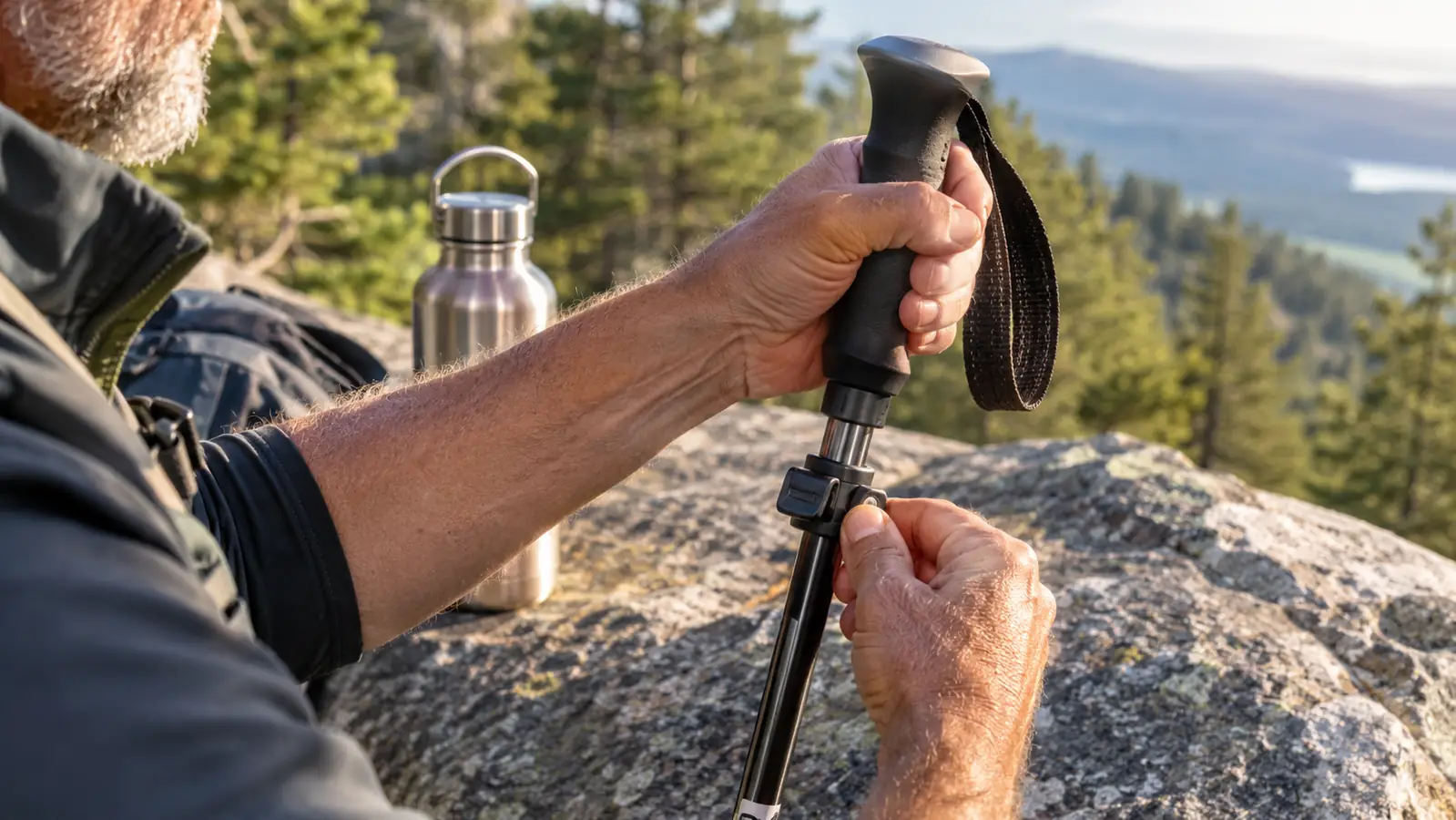
The grips are cork and EVA. I have sweaty hands, and cork has been better for me than the rubber grips I tried on a borrowed pair. On a warm August climb, the cork stayed dry enough that I did not have to stop and wipe my palms. The EVA section below the cork is the part I use on climbs. I do not have a technical explanation for why it works. I just know that my hand fits there, and I can push down without the pole sliding around.
The grip test I did not plan came in July, on a canyon trail above Ogden where I climb about 800 feet in a little over a mile and stop three times to breathe. The summer before, I borrowed a pair with rubber grips and by the second stop my palms were slick enough that I was squeezing harder than I needed to. With the cork on the Cascade Mountain Tech poles, my hands stayed dry enough to keep my grip loose, and loose hands meant less ache in my forearms by the top. That is the whole mechanism as far as I can tell. Nothing clever, just a material that does not turn into a bar of soap.
The tradeoff is that these are not featherweight. If you are counting grams, there are lighter poles. I am 5 feet 11 inches and about 190 pounds, and I would rather have a pole that takes a hit than one that saves me two ounces and folds when I need it. That is a personal call, not a rule.
The Quick Locks and the 26-to-54-Inch Range
The poles adjust from 26 to 54 inches. I am 5 feet 11 inches, and I set mine so my elbow is at about 90 degrees when the tip is on the ground. On descents I lengthen them a few inches. On climbs I shorten them. The quick locks are the part I check most often. They have held, but they are not set-and-forget. I give each one a firm press before a trip and I have never had one slip on the trail. I have had to tighten one after a season of use, which took a few seconds.
The collapsed size is 26 inches. That is short enough to fit behind the seat of the Tacoma without taking up the space where I keep my boots. It also means I can strap them to the side of my pack when I want my hands free. The included clip is a small thing, but I use it. I clip the poles together when I store them so they do not rattle around.
I am not a person who reads the manual for fun, but I did read the part about the locks. The instructions say to check them before each use. That is good advice. I have a friend who ignored his and spent a mile walking with one pole shorter than the other. It is not a failure of the pole. It is a failure to glance at it.
Tips, Baskets, and the Little Parts That Matter
The poles come with tungsten carbide tips, rubber tips, mud baskets, snow baskets, and a carry case. I use the carbide tips on dirt and rock. I put the rubber tips on when I am walking on pavement or when I am loading the poles in the truck and do not want the carbide scratching the bed. The mud baskets stay on in spring. The snow baskets come out for the few late-season trips when there is still snow in the shaded sections. I have not lost a basket yet, which is more than I can say for the old pair I borrowed.
The tip kit is the part I did not expect to care about. I have replaced nothing so far, but I like knowing the rubber tips are in the bag. The carbide tips have stayed sharp enough to bite into ice and packed dirt. I have not had one pop out. I check them at the start of each season and I have not found a loose one.
The snow baskets earned their keep in June two years back, on a north-facing stretch near Mirror Lake where the drift holds on long after the trailhead is dry. Without a basket the pole punches straight through the crust and you get nothing back. With the snow basket on, it stopped where I put it. That is a fifteen-second swap that saved me from sliding on a section I had no business rushing anyway.
The carry case lives in the garage. I do not use it on the trail. It is useful for keeping the poles together when I am not using them for a few weeks. The clip is more useful to me day to day. I clip the poles to the outside of my pack when I need my hands for a scramble. That is not a feature the listing brags about, but it is the one I use most.
Where They Bug Me
I do not love the locks. They work, but they are not the smooth, set-it-once mechanism I have felt on more expensive poles. I check them. I tighten them. I have had one work loose after a long, dusty drive, which is not a trail failure but is a reminder that these are a tool you maintain. If you want a pole you never think about, you will pay more for it.
The grips are also not for everyone. Cork has been good for me, but it is a texture. If you have a death grip, you will wear through any grip. I had to learn to relax my hands. The poles did not teach me that. They just made it obvious.
And they are not light. At about 10 ounces per pole, they are not the first choice for someone counting every ounce. I carry them because my knee is more important than my base weight. If you are an ultralight hiker who has no knee trouble, you may not want the extra weight. That is a fair reason to look elsewhere.
What I Liked
- Quick locks held on every descent I used them, with a check before each trip
- Cork and EVA grips stayed usable in heat and rain
- 6061 aluminum took rock strikes without bending
- Adjusts from 26 to 54 inches, short enough to store behind a truck seat
- Includes carbide tips, rubber tips, mud and snow baskets, and a carry case
- Low enough cost that I did not feel I was buying a status symbol
Where It Falls Short
- Locks need periodic checking and one tightening after a dusty season
- About 10 ounces per pole is not ultralight
- Cork grip texture is a personal fit, not a universal one
- You need to read the lock instructions once, which I almost skipped
I have walked down from Fehr Lake with less swelling in my left knee than I had after a shorter descent without them. The pole did not fix my knee. It bought me the last mile.
What Three Seasons Did to Them
I bought these in summer 2023. They have been through three seasons, which for me means a handful of overnights each year, a lot of day hikes, and one trip where I used them as a tent pole backup after I left a stake at home. They have scuffs on the shafts. The cork has smoothed where my hands sit. The locks still hold. The tips still bite. The baskets are still in the bag, which is a small surprise of organization, not a product feature.
The only maintenance I have done is tighten one lock and wipe the shafts with a damp rag. I have not replaced a tip. I have not lost a basket. I have not had a pole fail. That is not a dramatic story, and I am fine with that. I do not want my gear to be interesting. I want it to be boring and reliable.
The worst thing that happened to the Cascade Mountain Tech poles was my own fault. I set them down on a windy ridge above the Weber drainage while I dug a jacket out of my pack, and one of them went over the edge and bounced down a granite slab. I climbed down, picked it up, wiped off the grit, and checked the lock. There is a nick in the lower shaft about a foot above the tip and the section still slides and clamps the way it did on day one. I would not try that again, but I am not babying these either.
The scuffs are cosmetic. The aluminum has a few marks from rock, but no dents that affect the lock or the length. I would not call them pretty. I would call them mine.
Who This Is For
This is for the hiker with a knee that talks on descents, the person who wants two poles and does not want to spend carbon money, and the car camper who wants a pair that can live behind the seat and come out for a steep day hike. It is also for the person who is 40 or older, who is not trying to set a record, and who would rather finish the trip without an ice pack. If that sounds like you, the Cascade Mountain Tech poles are a sensible place to start.
It is for the person who will check the locks. That is the one habit these poles ask of you. If you can do that, they will do their job.
Who Should Skip It
Skip them if you are counting ounces for a long thru-hike and every gram is a decision. Skip them if you want a pole you never have to think about and you are willing to pay for that. Skip them if you have a hand or wrist issue that makes a cork grip uncomfortable, because grip is personal and no review can settle it for you. And skip them if you are looking for a pole to fix a knee. They do not fix anything. They share the load. The rest is your doctor, your exercises, and your judgment.
I still use mine. I still check the locks. I still shorten them a few inches going downhill. That is the whole review.
If your knee is the thing deciding your trips, start here
These are the poles I have used for three seasons on the Wasatch and in the Uintas. They are not the lightest and they are not fancy. They are the pair I trust on a long descent.
Amazon Check Today's Price on Amazon →