

I bought the Gear Doctors Oxylus in the summer of 2023 for the least romantic reason a person can buy a sleeping pad. I had spent one night on a thin closed-cell foam pad at a trailhead off the Mirror Lake Highway, and my lower back stayed angry for four days. Not the kind of soreness you stretch out over morning coffee. The kind where you sit down on the tailgate to put your socks on.
I am 58, 5 foot 11, about 190 pounds, with a left knee that files a complaint after every long descent. I camped through my twenties and thirties on whatever was cheap, and for most of those years I treated sleep as the tax you pay for being outside. Somewhere in my fifties that stopped being a fair trade. A bad night now costs me the whole next day, and a bad day on a trail with a sore back is not a trip I want to take anymore. So I went looking for a pad I could live with for years instead of a season. This is what three and a half seasons on the Oxylus has looked like.
The Quick Verdict
It ended the four-day backache and I still own it three and a half seasons later. It also weighs 2.2 pounds and makes me do the last few breaths myself. I will take that trade.
Amazon Check Today's Price →The pad that got my back off the foam
Self-inflating, 4.3 R-value, 1.5 inches of foam, and a valve I have not had to think about since 2023.
Amazon See Today's Price on Amazon →How I've Used It
Three and a half seasons means something specific. Roughly thirty nights in the Uintas along the Mirror Lake Highway, a handful in the Wasatch above Ogden in early fall, and two spring trips out near Moab where the ground is more rock than dirt. Nights at 8,500 feet in July on a pad that never felt cold underneath. One night in late September that dropped to about 28 degrees, which is the coldest I have pushed it. Enough unrolling and rolling that I have stopped thinking about the pad at all, which is the highest compliment I can pay a piece of equipment.
One of those Moab trips is worth describing, because it is where I learned the pad has limits. Spring, sandy ground over a shelf of rock, and I pitched without clearing the site the way I should have. I spent the first night on a lump under my hip and the second night on the same spot after moving the tent two feet. The pad did not puncture and it did not care. Its job is to be a consistent surface, and a consistent surface on top of a rock is still a rock. I now carry a small square of closed-cell foam for that. The repair patch that came in the bag is still in the bag, unused, which is how I like my repair patches.
It rides in the back of a 2014 Toyota Tacoma most of the year, which is not where anyone should store a sleeping pad. When I get home I unroll it under the guest bed with the valve open and leave it there until the next trip. That is the entire maintenance routine. No washing, no special hanger, no talc. The only rule I follow is keeping it out of the garage, because an Ogden garage in July gets hot enough that I do not trust anything with foam in it out there.
I bought it after that foam-pad night and I have not slept on anything else since. Not out of brand loyalty. Out of not having a reason to look. That is what a long-term review should tell you: the point where a product stops being an experiment and becomes the thing you just use.
What a 4.3 R-Value Means on a Cold Night in the Uintas
The Gear Doctors Oxylus is rated at 4.3 R-value, 1.5 inches thick, 72 inches long and 22 inches wide. Those numbers explain almost everything about how it sleeps. A 4.3 is a shoulder-season number. It is not a snow-camping pad and I would not pretend otherwise, and it is well above the thin summer pads that leave your shoulders cold from underneath at 9,000 feet in July.
The night that tested the claim was in late September in the Uintas, in my TETON 20 degree bag, wearing base layers and a beanie. It got to about 28. I was not warm the way you are warm in your own bed. I was warm enough to sleep, which is a different and more useful standard. The ground under me never turned into the cold spot, and that cold spot is what wakes me up on lesser pads. My shoulders and hips stayed off it all night.
What I cannot tell you is how a 4.3 behaves on snow. I do not camp on snow. I am 58 and I like my truck and my coffee too much. If winter camping is your plan, this review will not settle that question for you and you should be shopping a much higher number.
The Valve, the Setup, and What I Do Differently
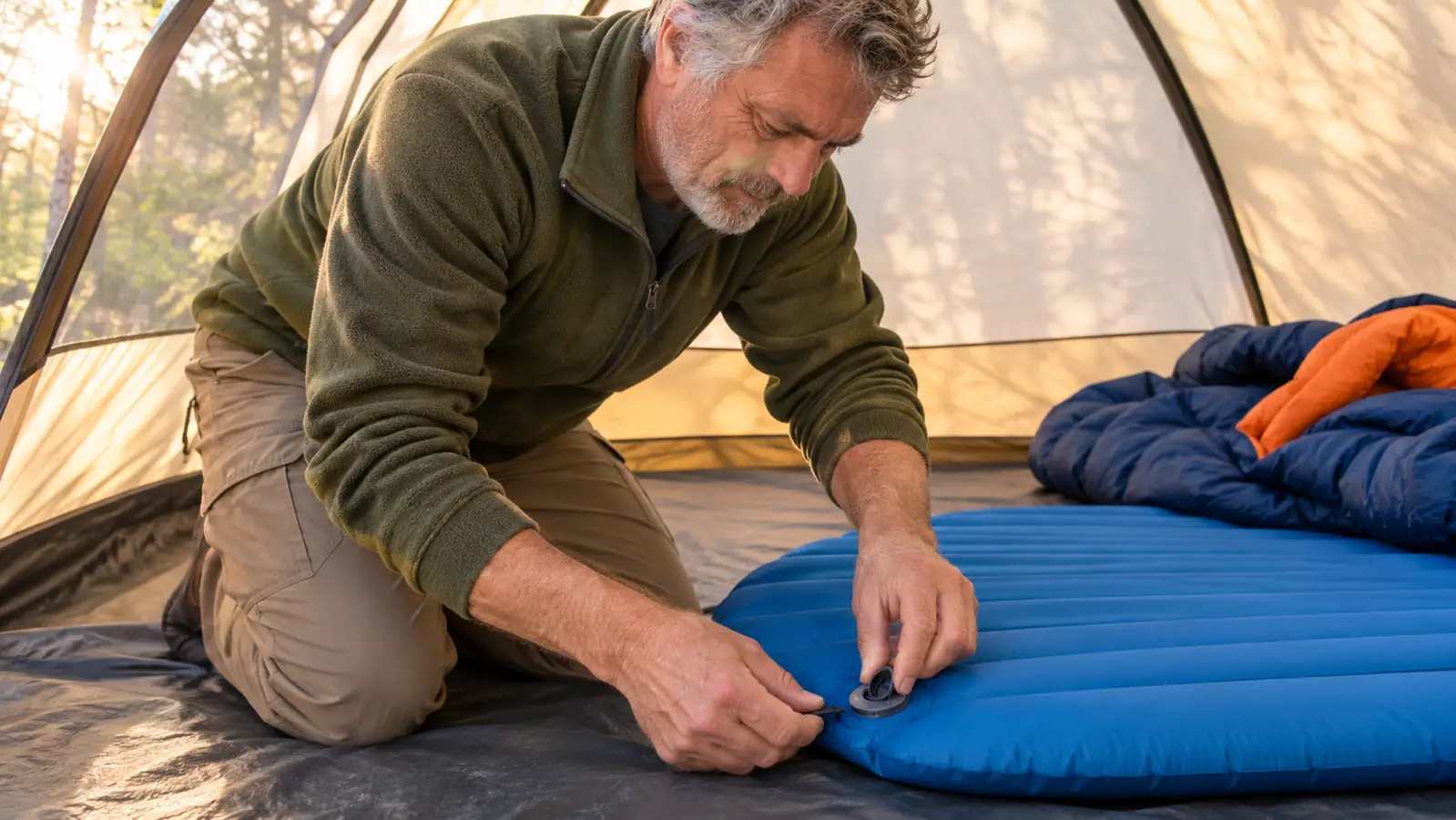
Self-inflating means the foam inside wants to expand and pulls air in when you open the valve. It does not mean the pad inflates itself while you stand there watching. On the Oxylus you unroll it, open the valve, let it do most of the work, then close the valve. Then, in my case, you put a few breaths in to take it from mostly firm to where I actually want it.
I got the firmness wrong for the first month. I overfilled it on the first trip, which is what a person does when he is used to air mattresses, and spent a night rolling off a pad that felt like a bench. The next trip I underfilled it and woke at 3 am with my hip on the floor of the tent. It took three more trips to find the setting, and the setting is roughly two full breaths after the foam stops pulling. I know that number now the way I know how much salt goes in chili. It is not written on the pad anywhere, and the instructions do not give it, because there is no number to give.
The listing says pack to sleep-ready in under five minutes. My real number is closer to seven, and most of that is me being fussy about firmness, not the pad being slow. I open the valve the second my pack comes off, then pitch the tent, then come back to it. By the time the tent is up and the bag is laid out, the pad has done its part and I am just topping it off.
Firmness is where a self-inflating pad asks something of you that an air pad does not. You are the pump for the last little bit. Some people hate that and I understand why. I have come to prefer it, because I can feel the firmness as I go and stop when my back says stop. With a pure air pad I am guessing, and I have guessed wrong at 10 pm more than once. The valve has been the quiet success of this pad. Three and a half seasons, no grit in the seal, no slow leak I have caught. I close it before I roll it, which is the one habit that keeps grit out.
Sleeping on 1.5 Inches With a Stiff Lower Back
Here is the part I did not expect. 1.5 inches does not sound like much next to the four and five inch air pads people brag about. But thickness and support are not the same measurement. An air pad is a balloon. Put 190 pounds on a balloon and the heavy parts sink while the light parts float. A self-inflating foam pad pushes back more evenly, and for my back that push-back matters more than the height.
I tested the comparison on purpose last summer, on a two night trip with Ray, who sleeps on an air pad and loves it. He handed me his for the second night and I handed him mine, which is the sort of thing friends do at 8,000 feet. I woke at 5 am with the ache already started and spent the morning walking it off before coffee. Ray said mine felt like a motel mattress, which from him is a compliment and also an accurate description. Neither of us changed our mind. He will keep his air pad because he is a back sleeper who weighs less than I do.
I am a side sleeper who rolls onto his back sometime around 2 am. On the borrowed air pads, my hip would bottom out and I would wake with the ache that starts low and runs toward the hip. On the Oxylus, at the firmness I like, my hip does not reach the ground. Not by a lot. By enough. I get up stiff in the way any 58-year-old gets up stiff, and I walk it off in five minutes, which is the normal shape of my mornings. What I do not get anymore is the four-day backache that sent me shopping in the first place.
I am not going to tell you it sleeps like a bed. It is a camping pad and it sleeps like one. If your back is in worse shape than mine, no pad on a website is the answer, and you already know that better than I do. What I can tell you is that the gap between this and a thin foam pad was the gap between a trip and a recovery.
Weight and Packed Size in a Real Pack
The Gear Doctors pad weighs 2.2 pounds, is rated to 250 pounds, and ships with a carry bag and a repair patch. I am 190, so the pad is nowhere near its limit under me, which I think is part of why it has held up. On weight, 2.2 pounds is heavy to anyone who argues about grams. I know that. I have borrowed a lighter air pad and slept badly on it, and I have decided I will carry the extra pound and sleep.
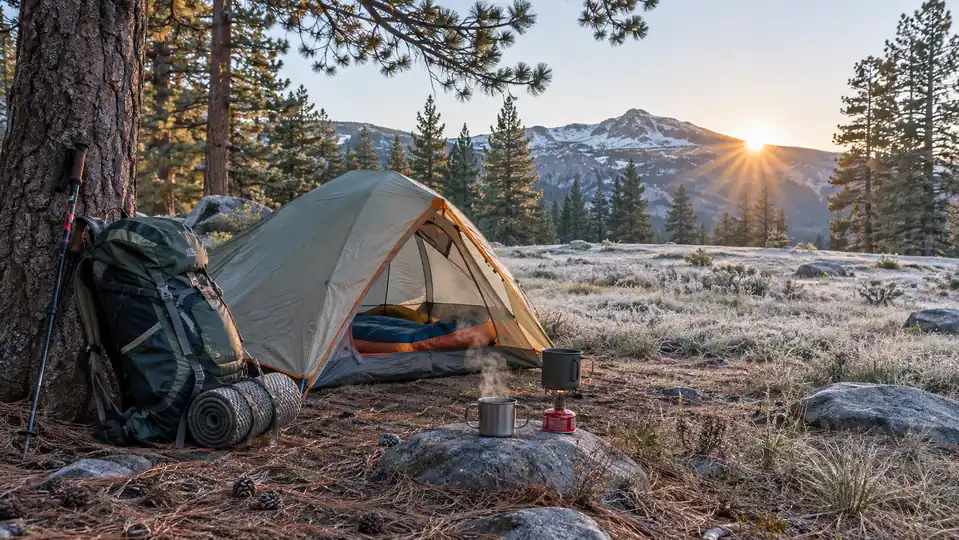
The packed roll is roughly the size of a sleeping bag in its sack, which is the honest comparison. It goes on the outside of the pack, under the top strap, not inside, and that is a decision I made in the first season and have not revisited. Inside the pack it eats the space I want for food and a jacket. Outside, it gets rained on, which is why I keep the carry bag on it. The carry bag itself is thin and I expect it to fail before the pad does.
It rolls up tighter than I expected for a foam pad and straps to the outside of my pack without drama. In the truck it lives in the tote with the tent and the stove. For a one or two night trip, which is what my life allows right now, 2.2 pounds is a cost I pay once on the way in and then forget. On a five day trip I might feel different, but I do not take five day trips, so I am not going to invent an opinion about it.
Two things genuinely bug me. The first is the last few breaths, because on a cold night that means putting your mouth on a cold valve. The second is bulk, because foam does not compress the way air does, and anyone who tells you this packs as small as an air pad is selling something. I have made peace with both. Width is the other one. At 22 inches it is a single, and I would take an inch or two more across the shoulders if it were offered.
What I Liked
- Self-inflating foam holds up a 190 pound side sleeper without bottoming out
- 4.3 R-value was enough on a 28 degree September night in the Uintas
- Firmness is tunable by feel, a few breaths at a time, instead of by guesswork
- The valve has stayed clean and leak free for three and a half seasons
- Carry bag and repair patch included, and the maintenance routine is nothing
Where It Falls Short
- 2.2 pounds is heavy next to a comparable air pad
- You finish the inflation yourself, which means a cold valve on a cold night
- Foam does not pack down as small as air
- The stated 250 pound capacity rules out bigger sleepers
- At 22 inches wide it is a single, and I would pay for more shoulder room
The ground never turned into the cold spot and my hip never reached it. Two small facts, three and a half seasons, and they are the whole reason I still own this pad.
Who This Is For
Adults who have crossed the line where one bad night ruins the next day. If you are over 40, if you car camp or take one or two night backpacking trips, and if your back has started filing complaints after a night on thin foam or a balloon, this pad was built for that exact person. It also suits anyone who does not want to think about their pad, does not want to baby it, and is willing to carry 2.2 pounds to stop worrying about it.
It suits side sleepers and people who roll around at night, because the foam pushes back instead of puddling under the heaviest part of you. It suits shoulder-season camping, where a 4.3 R-value is doing real work on a September night at altitude. And it suits anyone whose trips are short, because the weight only gets paid once.
Who Should Skip It
Skip it if you count grams. If your pack list has a real weight budget, 2.2 pounds for a pad blows it, and you already know that. Skip it if you need small packed volume, because foam takes up room that air does not. Skip it if you are over 250 pounds, since that is the stated limit and I would not push past it. Skip it if you want a pad that finishes itself with no effort, because this one expects a few breaths at the end.
And skip it if your back problem comes with a diagnosis attached. Talk to your doctor and buy something with a generous return window. I am a guy in Ogden who found a pad that works for his particular back, not a specialist, and I would rather you spend your money well than agree with me.
Three and a half seasons in and it still holds air
If your back has started deciding whether a trip happens, this is the pad that got mine back on the calendar. Self-inflating, 4.3 R-value, 1.5 inches of foam, 2.2 pounds.
Amazon See Today's Price on Amazon →