
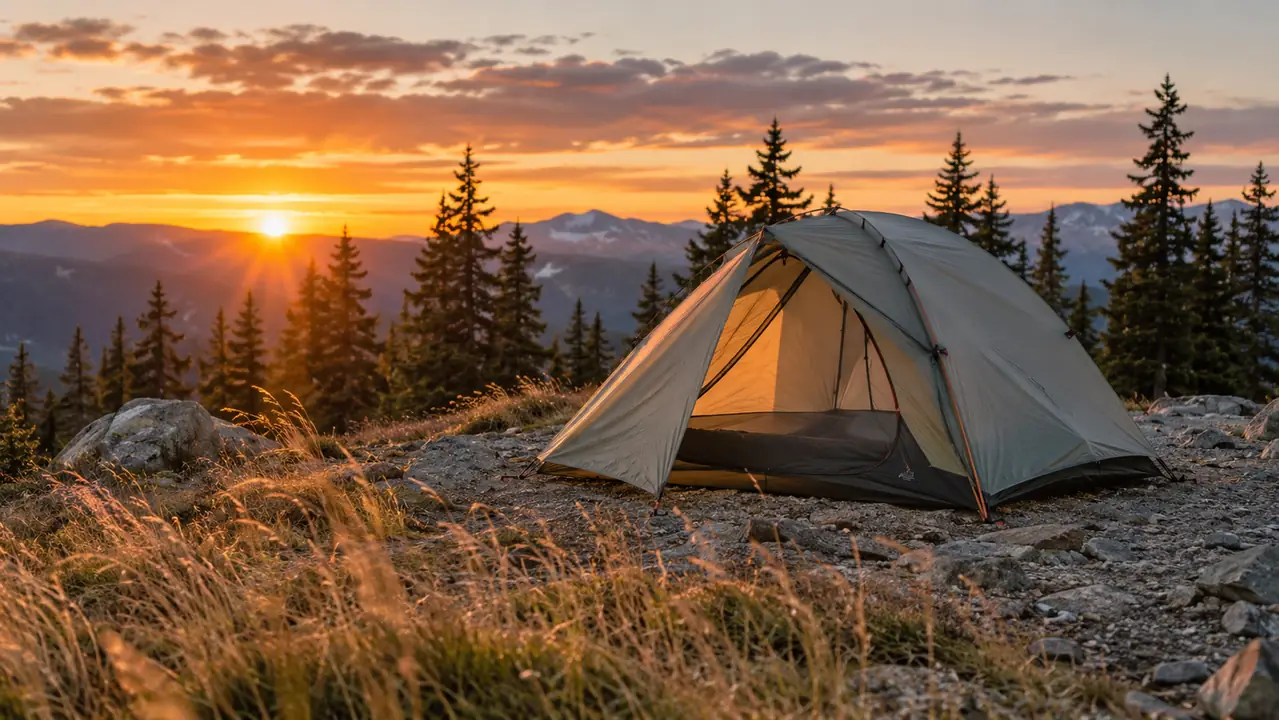
Wind is the part of backpacking nobody plans for. You hike in on a calm afternoon, the lake is glass, the forecast says ten miles an hour, and then around two in the morning the ridge starts humming and your tent turns into a flag. I have spent a bad night in the Uintas holding one pole with my hand and pinning the floor down with my knee, and I do not care to repeat it. A stiff lower back does not forgive that kind of night.
Here is what I have learned since. The fix is not a heavier tent and it is not a different tent. It is order of operations. I bought the Naturehike Cloud-Up 2 in the spring of 2024 and it has been my backpacking shelter for about three seasons now, mostly on the Mirror Lake Highway trailheads and the Wasatch above Ogden. It is a freestanding, three-season, two-person tent at 4.3 pounds, it comes with its own footprint, and the fly is 210T polyester with a 3000mm waterproof rating. Those numbers are fine. What actually keeps it standing in wind is the sequence below. Naturehike does not put this in the stuff sack, so I will.
The tent I pitch in wind, three seasons running
The Naturehike Cloud-Up 2 is a freestanding two-person, three-season tent at 4.3 pounds, with the footprint included and five wind ropes in the bag. It packs to 15.7 by 5.1 by 5.1 inches, which leaves room in a 50 liter pack for everything else.
Amazon Check Today's Price on Amazon →Step 1: Read the ground and the wind before you unclip anything
Walk the site with your pack still on. You are looking for three things: which way the wind is actually coming from, what is upwind of you, and where the ground is flat enough that you are not fighting a slope while you work. Wind at ground level is not the same as wind at head height. Watch the tops of the trees, not your jacket collar. The trees will tell you the true direction; your jacket will tell you about the last gust that happened to hit you in the chest.
Then pick your orientation. I put the low end of the tent into the wind and the door on the downwind side. The Cloud-Up 2 has a ventilation window above the front door, and that window is the one soft spot in an otherwise solid fly. Having it leeward changes how the tent behaves overnight. Facing the door into the wind for the view is a mistake I made once and did not enjoy.
Shelter beats scenery. A stand of lodgepole on the upwind side will cut more wind than any guyline you can rig, and it costs you nothing. What I will not do is pitch under a dead snag, or under the one heavy limb that looks like it could come down, no matter how good the protection is. I also leave the exposed point with the view to somebody younger. I am 58, and a view is not worth a night of listening to nylon snap while I lie there wondering if I remembered to stake the downwind corner.
Two Septembers ago I pitched at a trailhead off the Mirror Lake Highway with the forecast calling for ten to fifteen. By nine the tent was shaking hard enough that I got up and re-set the upwind stake with a flat rock on top of it. That is the night I stopped trusting a forecast and started walking the site first, wind in my face, hands out of my pockets.
Step 2: Lay it out low and stake the upwind corner first
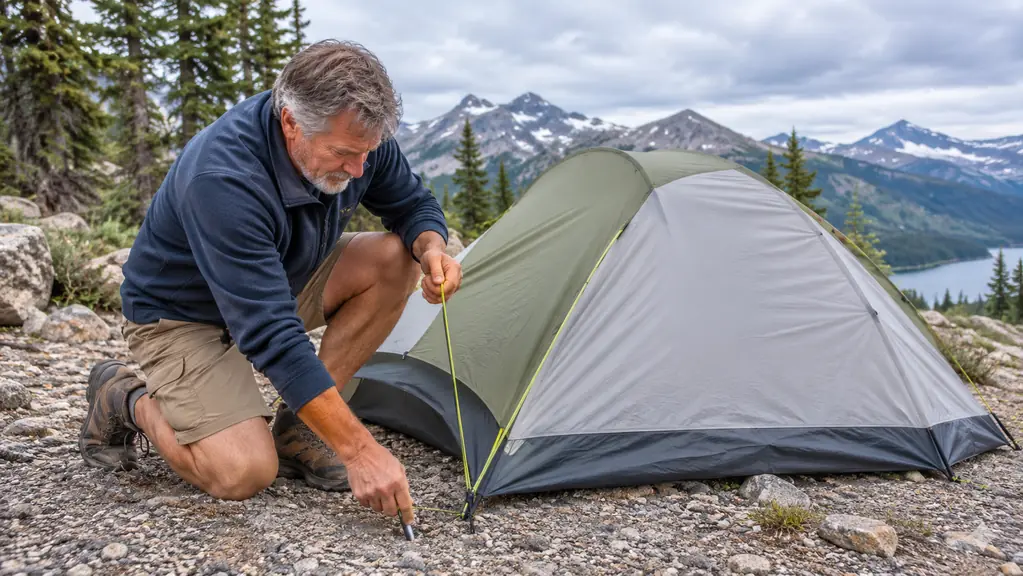
Unroll everything and keep it low. Wind gets under a loose tent body faster than anything else, and the moment it does you are chasing it across a meadow. I lay the footprint down first, then the body on top of it, and I set my pack on the upwind edge as a weight while I work. A pack with a sleeping pad and a bag in it is about the best doorstop there is.
Stake the upwind corner first, then the two corners beside it. Leave the downwind corner loose. You are building a hinge, not a box. Once those three points are down, the body cannot tumble, and you can let go of it with both hands and still find it where you left it.
The footprint that comes with the tent earns its few ounces here, not on the sleeping surface. It gives me a second set of corners to pin before the tent body is even out of the bag. On a site where I cannot get a stake into the gravel, I weight the footprint corners with rocks first and sort out the actual tent stakes afterward. That sounds fussy. It takes about ninety seconds and it is the difference between a calm pitch and a wrestling match.
The first time I did this in real wind, I staked the downwind corner first because it was the closest one to my knee. The body inflated like a grocery bag and pulled both upwind stakes halfway out of the gravel before I got a hand on it. I had to start over with the light going. Upwind first is not a preference. It is the only order that has ever worked for me.
The tent is 82.7 inches long and 41.3 inches tall at the center. That number wins no argument on a gear forum. It is the number that decides whether I sleep or lie there listening to the fly.
Step 3: Build the frame and clip the body while it is still flat
Assemble the poles on the ground, on the downwind side, with every section pushed fully home. Do not shake them out upright like you see in the videos. A pole section that separates in a gust is a pole section you will spend twenty minutes crawling around looking for, and you will find it after you have given up.
The Cloud-Up 2 attaches the body with clips rather than sleeves. That is one of the reasons I bought it. Clipping is faster than threading a pole through a long sleeve, and more importantly the body is not committed to the frame until the frame is already built. On a windy evening that matters. Threading a sleeve means feeding a long pole into a long tube while the tube is trying to leave.
Do all of the clipping while the tent is still lying flat. This is the step where people lose the tent. If you raise the body before the last clip is on, you have a sail with one edge nailed to the ground, and the wind will find the loose corner every time. Flat, fully clipped, and only then upright.
One evening in the sage above Ogden a gust took my half-built frame and rolled it a good ten feet before I got a boot on it. Nothing broke, which was luck more than anything. But I spent ten minutes on my hands and knees in the brush hunting one pole section, and I have built the frame flat on the ground with the wind at my back ever since.
Step 4: Raise it and get the fly on without letting go
Raise the body, then get the fly out and over it immediately. Do not walk to the lake to look at the clouds. Do not go find your water bottle. Once the body is standing it catches everything coming across the ridge, and a freestanding tent that is not yet guyed out will skitter. I have watched one move a foot sideways with an open door acting as a scoop.
Put the fly on starting at the upwind end and work back. Attach the upwind corners first, then the sides, then the downwind end. If a gust hits while you are halfway through, the fly is already anchored at the end the wind is coming from and it will flap at you instead of launching. The order is the whole trick. Same fly, same tent, opposite outcome.
Keep the door zipped and the vents closed until the fly is fully attached. That single habit has saved me more than any piece of gear. An open door on a standing tent is a wind scoop, and a wind scoop will drag a shelter with your sleeping bag inside it before you can get a hand on it.
Step 5: Rig all five wind ropes and stop tensioning at the right point
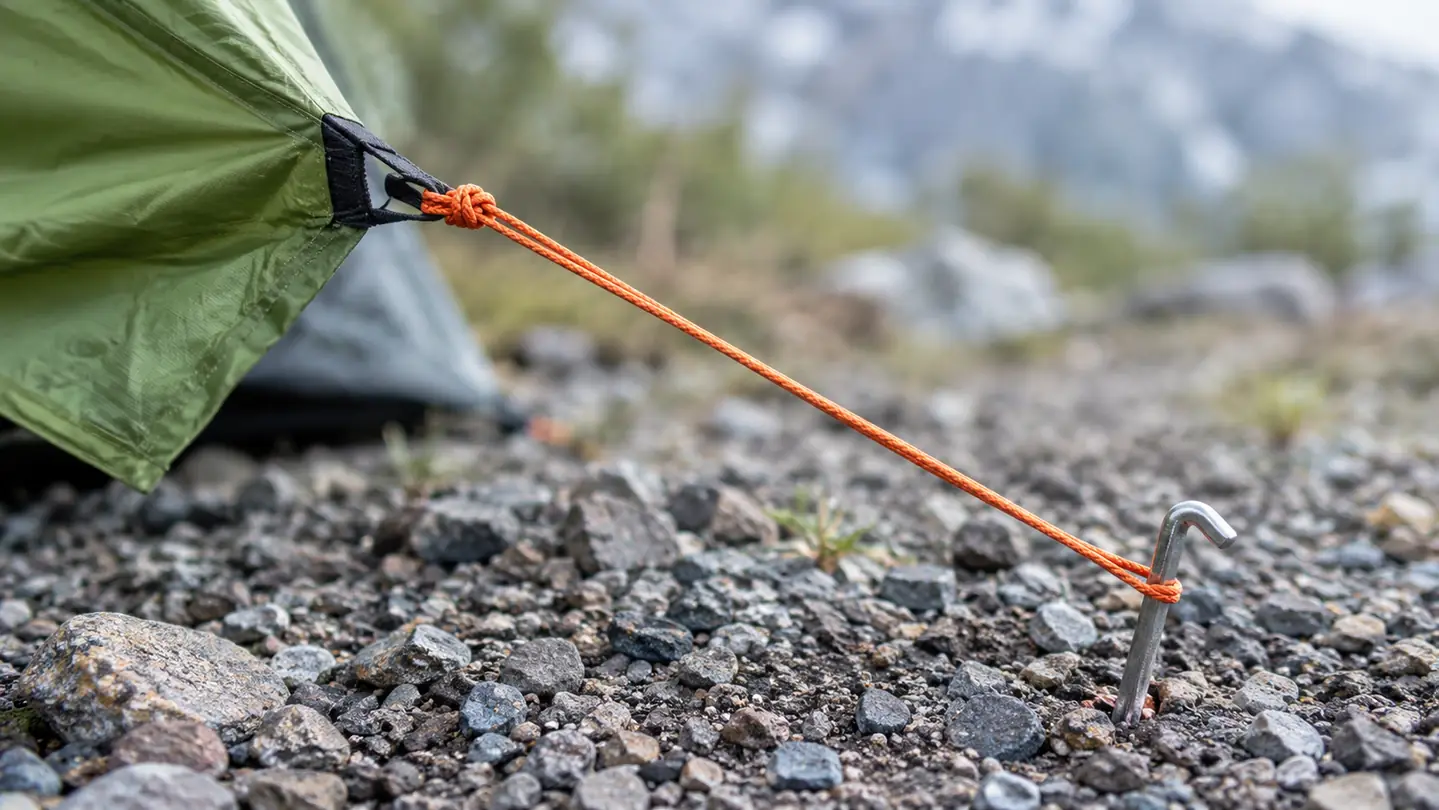
The tent comes with five wind ropes, and in anything above a stiff breeze I rig every one. Two at the head end angled out at roughly forty five degrees, two at the foot, and the fifth on the side taking the weather. Angled out, not straight down. A guyline that runs straight to the ground from the tent body does almost nothing except trip you in the dark.
Then tension, and then check the door. Over tensioning a fly pulls the zipper tight, and a tight zipper is a hard zipper at two in the morning when you need it in a hurry. I tension until the fabric stops flapping and not one turn past that. Then I walk the perimeter once and re stake anything that has gone slack, because the first ten minutes of wind will settle the whole thing and leave a corner or two loose.
The first night I rigged all five, the wind came across the ridge in long pushes instead of a steady blow, and the tent would go quiet for a minute and then shudder. What fixed it was not more tension. It was moving the foot end guyline about four inches wider and re staking it. Small adjustments, made by hand, are what settle a tent down.
Last thing before you walk away: put something inside. An empty tent is a kite with a floor. My sleeping pad and bag go in before I head off to filter water, and I leave my pack just inside the door. It weighs the floor down, and it means I am not crawling around in the dark later looking for a headlamp I left in the truck.
What Else Helps
A windbreak you build can beat a windbreak you buy. On a site with nothing upwind, I have stacked rocks into a low wall on the windward side, maybe eighteen inches high and as long as the tent. Keep it low so it does not become its own sail, keep it stable, and put the rocks back in the morning. It is not elegant and it has made the difference between a decent night and a long one more than once.
Two other pieces of my kit matter on a windy evening. My trekking poles go up against the truck or under the vestibule where I can find them, because a pole that blows away is a knee that pays for it on the descent tomorrow. And my water filter sleeps inside the bag with me when the temperature is dropping, since a frozen filter is a dead filter and I am not walking out with a dry bottle.
One honest note about the tent. At 4.3 pounds it is not the lightest thing in the category, and if you are counting grams for a thru hike you will look elsewhere. The 82.7 by 49.2 inch floor is generous for one person and workable for two people who like each other. It has held up for three seasons of short trips, stored loose in a plastic bin in my garage rather than stuffed in the sack, and the poles and clips are still the originals. That is the trade I wanted: a shelter I can pitch in wind without thinking hard about it, at a weight I can carry up a trailhead at 58 with a complaining left knee.
Pitch it once in wind and you will stop dreading the forecast
Freestanding frame, clip attachment, five wind ropes, footprint included, 4.3 pounds packed into 15.7 by 5.1 by 5.1 inches. The Cloud-Up 2 is a three-season two-person tent built for exactly the kind of short trip most of us actually take.
Amazon Check Today's Price on Amazon →